Grain, Dye, and Light: The Cinematographers Turning Away From the Digital Palette
A quiet but consequential revolt is unfolding behind the camera. Across American and international productions alike, a growing cohort of cinematographers and colorists is deliberately turning away from the seamless, infinitely malleable world of digital grading in favor of chemical processes, optical printing, and hand-crafted visual textures. This is not nostalgia. It is an argument about what images are capable of feeling.
For much of the past two decades, digital color grading has operated as the industry's default mode of visual expression. Its advantages are real and considerable: precision, repeatability, non-destructive editing, and the ability to achieve effects that would have required elaborate practical setups in any prior era. Yet for a generation of cinematographers who came of age watching that precision calcify into a kind of visual monoculture—the ubiquitous teal-and-orange palette, the hyperreal clarity of over-sharpened digital acquisition—the reaction was perhaps inevitable.
The question now animating serious conversations in American cinematography is not whether analog methods can compete with digital ones on technical terms. It is whether they offer something that digital processes are structurally incapable of replicating.
The Homogenization Problem
To understand the appeal of the analog resurgence, one must first reckon honestly with what digital standardization has cost the medium. The democratization of high-quality digital filmmaking has been, in many respects, an unambiguous good. Barriers to entry have fallen. Stories that might once have required substantial financial investment to capture with any visual sophistication can now be realized on modest budgets. The range of voices in American independent cinema has expanded measurably as a result.
But democratization carries its own aesthetic risks. When the same software pipelines, the same camera systems, and the same grading tools are available to virtually every production, the visual language of cinema tends toward convergence. A prestige television drama, a mid-budget thriller, and an independent character study can emerge from the color suite looking as though they were photographed by the same hand—not because the cinematographers lacked individual vision, but because the tools through which that vision was filtered imposed their own homogenizing logic.
This is the context in which the analog revival must be understood. It is not a retreat from technology. It is a deliberate act of differentiation.
What Film Grain Actually Does
The return to photochemical processes—whether through shooting on 16mm or 35mm film, through optical printing techniques, or through the use of genuine chemical bleach bypass in the lab—is frequently mischaracterized as a stylistic affectation. Critics of the trend sometimes suggest that cinematographers are simply manufacturing imperfection as a substitute for genuine visual intelligence.
This reading misunderstands the nature of analog texture. Film grain is not a decorative overlay. It is the direct physical record of light interacting with silver halide crystals suspended in an emulsion. Every frame of film carries within it evidence of its own creation—a temporal and material specificity that digital acquisition, however sophisticated, approaches only through simulation.
Contemporary cinematographers working with practical film stocks understand this distinction acutely. The grain structure of Kodak Vision3 500T in low light does not merely look different from a digital noise pattern. It behaves differently across cuts, responds differently to motion, and carries a different relationship to the human eye's perceptual systems. These differences accumulate across the length of a film to produce an experiential quality that is genuinely difficult to quantify but unmistakable in the viewing.
Productions such as Aftersun (2022), shot by Gregory Oke on a mixture of 16mm and Super 8 alongside digital formats, demonstrated that the deliberate incorporation of analog textures could function as a narrative device rather than mere atmosphere. The degraded, temporally unstable quality of the film's home video sequences did not simply suggest memory. It enacted the unreliable, fragmentary nature of recollection in a way that pristine digital imagery could not have achieved with equivalent emotional force.
Hand-Painted Sets and Practical Color Sources
Beyond photochemical processes, the analog revival extends into production design and practical lighting in ways that are reshaping conversations between cinematographers and their collaborators.
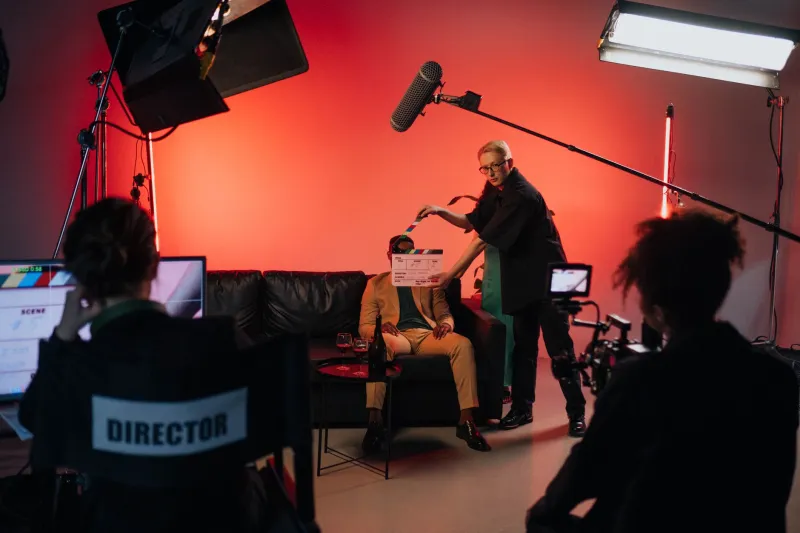
The decision to source color from within the frame—through painted surfaces, practical light sources with gel filtration, and carefully controlled environmental hues—rather than applying it in post-production represents a fundamental philosophical shift in how visual identity is constructed. When a set is painted in a specific palette and lit to emphasize those choices in-camera, the resulting image has a physical coherence that digitally graded color frequently lacks. The light falls differently on surfaces that were designed to receive it. The relationships between hue and shadow behave according to optical laws rather than algorithmic interpretation.
This approach demands considerably more preparation and imposes genuine constraints on the post-production process. Choices made on set are not easily reversed. But for many cinematographers, this irreversibility is precisely the point. Commitment to a visual language at the production stage produces images with a kind of internal consistency—a sense that the world of the film obeys its own physical rules—that audiences register emotionally even when they cannot articulate it analytically.
The Authenticity Debate
The resurgence of analog methods has not escaped criticism, and the counterarguments deserve serious consideration. Some practitioners contend that the fetishization of analog process conflates material authenticity with artistic authenticity—that a film shot on celluloid is not inherently more emotionally honest than one captured digitally, and that the pursuit of grain and optical imperfection can become its own form of affectation.
This is a legitimate tension. The history of cinema offers ample evidence that extraordinary visual poetry is achievable through purely digital means. The work of Roger Deakins—whose mastery of digital cinematography has produced images of startling beauty and emotional precision—demonstrates that the tools themselves are not determinative. What matters is the intentionality brought to their use.
The more nuanced argument, and the one that the most thoughtful practitioners of the analog revival tend to advance, is not that digital processes are inferior but that they carry specific tendencies that require active resistance. The ease with which digital grading allows for revision can become an obstacle to decisive creative commitment. The smoothness of digital acquisition can produce a visual register that, however technically accomplished, lacks the indexical relationship to physical reality that film maintains.
A Fundamental Debate About What Images Are
At its deepest level, the conversation unfolding between analog advocates and digital practitioners is a philosophical one. It concerns the question of what a cinematic image fundamentally is—a record of light, a constructed artifact, an emotional instrument, or some irreducible combination of all three.
The cinematographers returning to chemical and mechanical processes are, in effect, insisting that the means of image-making are never neutral. That the tools through which a film is created leave traces—aesthetic, perceptual, and emotional—that shape the audience's experience in ways that cannot be fully separated from narrative or performance.
This is a serious claim, and it is one that the current moment in American cinema is uniquely positioned to test. As productions continue to explore the creative possibilities at the intersection of analog and digital methods, the images they produce will either validate or complicate that argument. Either way, the conversation itself represents one of the most generative debates in contemporary cinematography—a field rediscovering, with considerable sophistication, that the frame is never simply a window. It is always, in some sense, a material object.