Frame by Frame: The Archivists Racing to Save America's Vanishing Film History
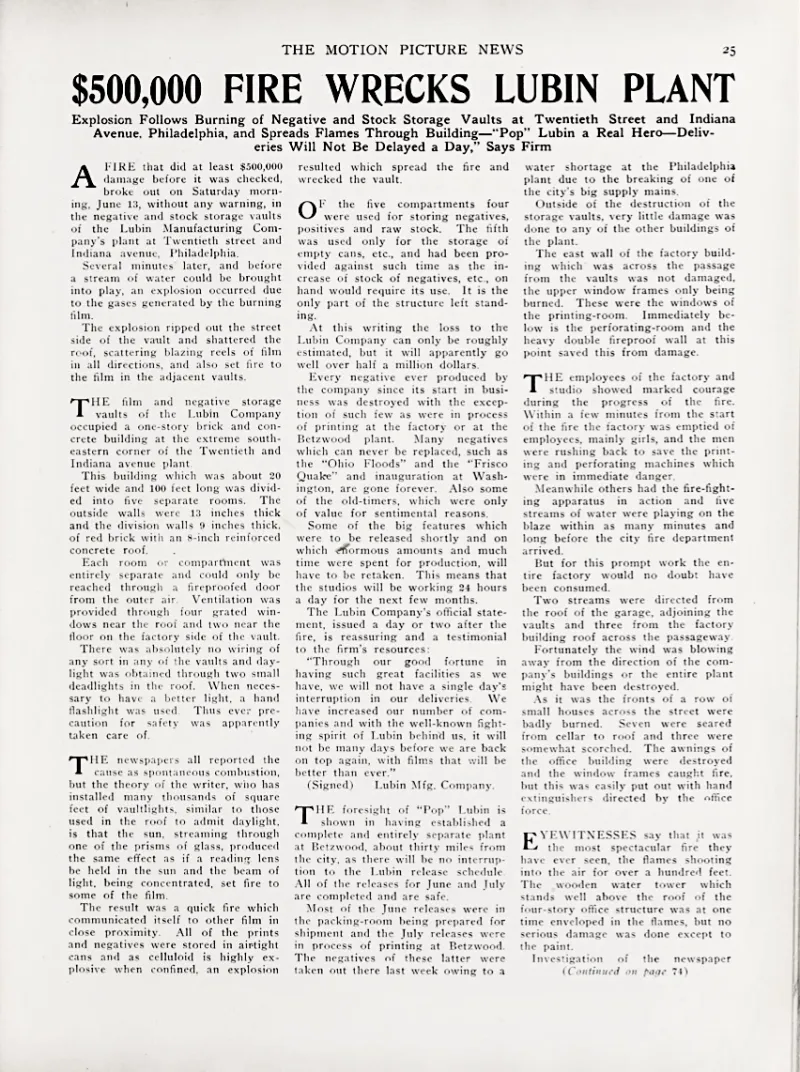
Photo: Article by staff writer for and typeset for cited 1914 issue of The Motion Picture News, Public domain, via Wikimedia Commons
In a climate-controlled vault outside Los Angeles, a reel of 1910s nitrate film rests in a can, its edges beginning to crystallize into vinegar-scented decay. It is not metaphorical that archivists call this process 'vinegar syndrome.' It is chemistry, it is irreversible, and it is happening to thousands of reels of American film history at this very moment. The people racing against it are, by any reasonable measure, among the most important figures in cinema—and almost no one knows their names.
The Chemistry of Oblivion
Celluloid was never meant to last forever. Nitrate stock is chemically unstable and dangerously flammable; acetate stocks shrink, buckle, and release acetic acid as they deteriorate. Meanwhile, the digital era introduced its own fragility: hard drives fail, formats obsolesce, and files without diligent migration can vanish faster than any film stock ever did.
Restoration labs—the best-known of which operate under studios, archives, and nonprofits like the Film Foundation—have spent decades performing meticulous surgery. Technicians clean each reel by hand or by ultrasonic bath, scan frames at 4K resolution, and then begin the delicate work of reconstruction: matching trims, consulting release paperwork, and rebuilding films that sometimes survive only in fragments scattered across continents.
The Colorist as Interpreter
Once the scan exists, the colorist enters. This is where restoration becomes interpretation. Reference prints, original camera negatives, and even the memories of surviving crew members guide decisions about whether a 1970s film should carry the faded warmth of its Eastman stock or the richer tones its cinematographer intended.
"Our job is to disappear," one veteran colorist explained. "If a viewer notices my work, I've failed." The best restorations are invisible—audiences simply see the film as it was meant to be seen, unaware that hundreds of hours of judgment stand between the vault and the screen.
The Streaming Paradox
The current moment is a strange one. Streaming has made more classic cinema accessible to more Americans than at any point in history—and simultaneously made the survival of that cinema more precarious. Rights-limited catalogs quietly delete titles overnight. Studios have shelved completed films as tax write-offs, placing finished work under legal lock and key. And as physical media sales dwindle, the discs that once served as durable, consumer-owned archives are disappearing from store shelves.
Archivists are blunt about the stakes: a streaming file is not an archive. Preservation requires multiple copies, multiple formats, multiple locations—and, crucially, a legal and institutional commitment to keep them. The shelf is not nostalgia. It is redundancy, and redundancy is survival.
Why the Frame Is Worth Fighting For
There is a temptation to view film restoration as a hobbyist's concern, a matter of interest only to collectors. But cinema is America's most significant indigenous art form and one of its most complete historical records—a century of how the country dressed, argued, dreamed, and lied to itself. When a film decays, a primary document decays with it.
The technicians in those vaults understand this. They work frame by frame, can by can, against chemistry and corporate indifference alike. Their triumphs are quiet: a silent film screened for the first time in ninety years, a lost independent restored in time for its director to see it whole again. Every frame saved is a small victory against oblivion—and collectively, they add up to nothing less than the preservation of the national memory in light and motion.