Cut to the Beat: How Film Editors Conduct the Emotional Orchestra of Modern Cinema
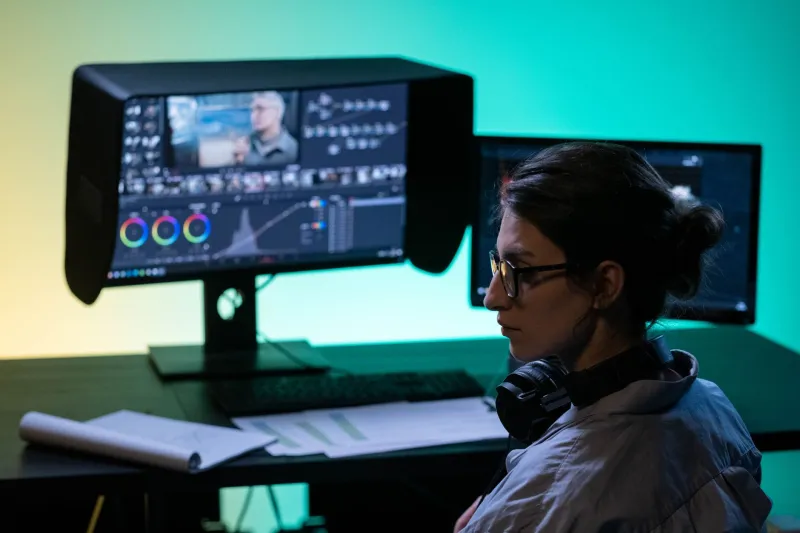
There is a moment in nearly every great film when the audience surrenders — not to a performance, not to a sweeping score, but to something far less visible and far more fundamental. It is the moment when the editing takes hold. When the rhythm of cuts begins to breathe with the viewer's own nervous system, when the space between images becomes as meaningful as the images themselves. In that moment, the editor — cinema's most underacknowledged architect — is conducting.
The analogy to music is not merely decorative. Editing operates on the same principles that govern musical composition: tempo, dynamics, phrasing, and rest. A cut made three frames too late can deflate a scene the way a drummer dragging behind the beat deflates a groove. A sequence assembled with metronomic precision can generate tension that no line of dialogue could manufacture. And yet, for decades, the editor's contribution has been folded into the mythology of the director, rendered invisible by the very success of the craft.
That invisibility is changing. A new generation of American film editors is asserting the editorial chair as a creative authority in its own right — and the results are reshaping how audiences experience story.
The Grammar of the Cut
To understand what editors actually do, one must first resist the common misconception that editing is a process of selection — of choosing the best take and arranging it cleanly. That description captures perhaps ten percent of the discipline. The deeper work is architectural. The editor determines not only what the audience sees, but when, for how long, and in what emotional context.
Consider the work of Lee Smith, whose collaboration with Christopher Nolan across films including Dunkirk demonstrated how non-linear editing could itself become a narrative argument. In Dunkirk, Smith's intercutting of three temporally distinct timelines — spanning one hour, one day, and one week — was not merely a structural choice. It was a rhythmic one. The compression and expansion of time across those threads created a physical sensation of dread and momentum that the film's spare dialogue could never have achieved alone. The editing was the score's emotional counterpart, and in many sequences, its superior.
Similarly, Thelma Schoonmaker's decades-long partnership with Martin Scorsese has produced some of American cinema's most kinetically charged sequences — not because the footage itself demanded such energy, but because Schoonmaker's cutting imposed a musical logic upon it. Her work on The Departed and Goodfellas demonstrates how editorial rhythm can define a character's psychology as precisely as any line reading. The rapid, almost percussive cuts during Henry Hill's paranoid final act in Goodfellas do not illustrate anxiety — they are anxiety, delivered directly to the viewer's cortex.
Montage as Melody
The Soviet filmmakers of the early twentieth century understood something that contemporary Hollywood has periodically forgotten: montage is not merely a technique for conveying information efficiently. It is a method for generating meaning that exists between images rather than within them. When two shots are placed in sequence, a third idea — invisible in either image alone — emerges from their collision.
This principle is alive and rigorously applied in contemporary American independent cinema. Consider the editorial construction of films like Moonlight — edited by Joi McMillon and Nat Sanders, who became the first Black editors nominated for the Academy Award in that category. Their work across the film's three chapters modulates tempo with extraordinary sensitivity, allowing scenes to breathe in ways that feel almost musical in their phrasing. A long, unhurried take is followed by a sharp cut; silence gives way to sudden environmental sound. The editing does not merely support the story of a young man's fractured identity — it enacts it.
The choice of when to cut is, in this sense, a compositional decision equivalent to a composer's choice of when to resolve a harmonic tension. Premature resolution feels cheap. Delayed resolution builds unbearable weight. The editor, like the composer, must feel the precise moment when the audience is ready.
Pacing as Argument
One of the most underexamined functions of editing is its capacity to make a philosophical argument through pacing alone. A film that moves slowly is not necessarily a patient film — it may be a film whose editor has determined that duration itself carries meaning. Conversely, a film assembled with relentless velocity is not necessarily an energetic film; it may be one whose editor is using speed to prevent the audience from thinking.
The editors working with filmmakers such as Paul Thomas Anderson — whose collaborations with Dylan Tichenor and later Leslie Jones have produced some of the most deliberately paced American films of the past two decades — understand that rhythm is rhetoric. The extended, uninterrupted scenes in There Will Be Blood make an argument about obsession and isolation that no amount of expository dialogue could replicate. The editing insists on duration because duration is the point.
By contrast, the furious editorial rhythm of films in the action and thriller genres — when executed with genuine craft rather than mere chaos — can achieve a similar philosophical clarity through opposite means. The editing of Mad Max: Fury Road, overseen by Margaret Sixel, demonstrated that kinetic cutting, when governed by a coherent internal logic, can be as emotionally precise as the most contemplative art-house pacing. Every cut in that film serves a spatial and emotional function; the audience never loses its bearings because the editor has maintained an underlying rhythmic grammar even within apparent pandemonium.
The Conductor Behind the Curtain
What distinguishes the finest editors from competent technicians is precisely what distinguishes a great conductor from a capable one: interpretive intelligence. The notes on the page — or the footage in the bin — are the same for everyone. What separates the transcendent from the merely proficient is the capacity to hear what the material wants to become, and then to impose that vision with both authority and sensitivity.
This is why the editor's relationship with the director is so frequently described in musical terms by the practitioners themselves. Thelma Schoonmaker has spoken of editing as a form of listening — to the footage, to the rhythm of performance, to the implicit tempo encoded in the way a scene was photographed. That listening is not passive. It is the active, interpretive labor of a musician who has internalized the score so completely that they can depart from it in service of its deeper truth.
As American cinema continues to evolve — navigating the competing pressures of streaming formats, shortened attention spans, and an expanding vocabulary of visual language — the editor's role will only become more central. The rhythm section of any great band is the foundation upon which everything else rests. In cinema, that foundation is built in the editing room, frame by deliberate frame.
The conductor's podium, it turns out, has always had a second occupant. We are only now beginning to properly acknowledge the one who has been sitting there all along.